The ongoing battle between those using AI to attack, and those using it to defend, rages on in 2026, alongside increasing concerns for the shaky geo-political climate that leaves ample scope for attackers to disrupt and weaken critical infrastructure.
According to the World Economic Forum’s 2026 Global Cybersecurity Outlook, 64% of organisations consider geopolitically motivated attacks a top consideration in their cyber risk strategy.
This volatile environment has become a breeding ground for:
- Supercharged ransomware attacks
- Sophisticated social engineering attacks executed quickly and at scale
- Disrupted supply chains
- Greater exploitation of software vulnerabilities
IBM’s 2025 Cost of a Data Breach study revealed that the average detection and containment of a data breach takes 241 days, with 50% of breaches caused by malicious activities and 23% by IT failure. Phishing and supply chain compromises are among the most vulnerable vectors, highlighting the need for organisations to tighten up both their data-sharing and vulnerability management efforts.
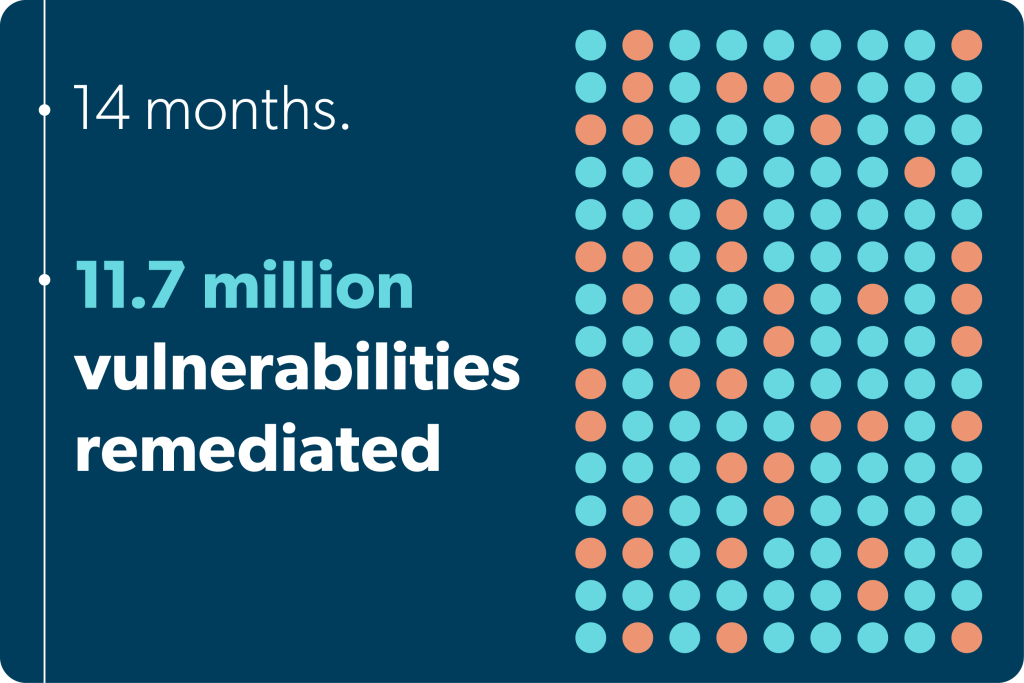
Between December 2024 and January 2026 alone, LIMA’s Vulnerability Detection and Remediation (VDR) revealed and remediated 11.7 million vulnerabilities in customer environments. The vast number of vulnerabilities identified emphasises both the scale of the challenge and the necessity of a strong solution to the problem.
Compromised supply chains because of worsening cyber inequity are a growing cause for concern in 2026. Interconnected organisations are exposed to an onslaught of vulnerabilities when there is a disparity between those with robust cybersecurity resources, and those without.
Cyber inequity highlights two major challenges in the 2026 cyber security landscape:
- A need for greater collaboration across organisations, supply chains and even nations
- The call for a level playing field for small-medium sized businesses (SMBs), whose IT teams are struggling against a swelling tide of vulnerabilities while continuing to manage day-to-day IT requirements
The pressure is on for internal IT teams to do more, with less time and fewer resources.
What are the top cyber security threats in 2026?
According to DeepStrike, by mid-2025 a jaw-dropping 21,500 vulnerabilities and exposures had been reported; an increase of 16-18% vs. 2024. But why are there so many vulnerabilities open to exploitation, now?
Let’s dive into the top three cyber security threats fueling this increasingly complex environment:
1. AI vs AI – The 2026 cyber security arms race
AI tooling has been integrated with what we might describe as reckless abandon, leaving technology and processes unchecked. Attackers are using AI to scout out and exploit the ample vulnerabilities, faster than IT teams can patch them.
2. More devices, more problems – The IoT threat to cyber security
We have more internet connected devices than ever. From phones and tablets to watches and headphones, we are all interconnected by a vast infrastructure of gadgets that lack adequate security protection and are vulnerable to attack. When compromised devices are connected to corporate networks without IT authorisation, it quickly becomes a problem for the entire business.
3. You’re only as strong as your weakest link – Securing your supply chain
Just as the breaching of one IoT device puts all interconnected devices at risk, the same is true for the supply chain. Smaller businesses, with IT teams that are underfunded and under-resourced, become easy targets for attackers with their eyes on a bigger prize.
Meeting Cyber Essentials Plus requirements
The challenges facing this already precarious ecosystem are compounded for organisations that lack the in-house cybersecurity expertise, or whose IT teams are already overburdened by endless patching to meet regulatory standards such as Cyber Essentials Plus.
“It’s been put on the IT team to manage vulnerabilities. If there are out-of-band patches released by the software or infrastructure vendor, you have 14 days to apply them, if they are classed as high or critical. That is a new responsibility that the IT team must deliver day or night, over seasonal holidays and periods of annual leave. My takeaway: is this actually the best use of our time? Given that the challenges in 2026 are more significant in terms of business transformation, is it the right thing to be spending the team’s time on these tasks?”
Ollie potts, head of product and presales, LIMA
This is an all-too-familiar tale for many IT teams whose responsibilities have evolved and expanded well beyond the team’s original remit and skill set, without the investment in both people and technology to support the changing requirements.
It’s simply not sustainable. The IT team needs investment in the right support, now.
The hidden risk inside your network: initial access and privilege escalation
Most organisations focus their security investment on keeping attackers out. Firewalls, endpoint protection, SOC services, MFA – all essential tools for defending the perimeter. But perimeter defences alone are not enough.
Once an attacker gets inside your network – whether through a compromised account, a phishing link, or a purchased credential – the question is no longer, where did they get it? But how much damage they can do once they’re there? That’s where unpatched software vulnerabilities become even more dangerous.
Known software vulnerabilities don’t just provide a route in, they provide a route through. A vulnerability in a browser, an application, or a network component can give an attacker the foothold they need to move laterally across your systems. Jumping from one asset to another, the attacker escalates their privileges, gaining access to sensitive data, financial systems or critical infrastructure that would otherwise be out of reach.
The stats back this up. 74% of data breaches involve the abuse of privileged credentials, and 46.6% of incidents now involve some form of privilege escalation.
A real-world example: a vulnerability in a widely-used browser could give an attacker an initial foothold on a standard user’s device. Low risk in isolation. But with the right unpatched vulnerabilities in place, that same attacker can move laterally across the network, reach higher-value systems and escalate their access, turning a minor breach into a major incident.
This is what LIMA’s VDR service is specifically designed to address. By continuously identifying and remediating known vulnerabilities across your entire environment, VDR takes away opportunities for attackers to move, escalate and cause maximum damage if they to get through, or bypass, your outer defences.
“You might be protected at the perimeter. But if an attacker gets in through phishing or stolen credentials VDR reduces the number of weaknesses they can exploit once inside the network. It limits escalation paths and prevents a small breach from turning into a major incident.”
Ed Maxwell, security consultant, LIMA
Do I need a strategic IT partner?
When it comes to detecting and remediating vulnerabilities, SMBs need their IT function to behave just as effectively as their enterprise counterparts if the interconnected ecosystem is to survive. We have to eliminate cyber inequity by seeking out partnerships that level the playing field, creating secure environments regardless of the size of a business’s IT team.
Steve Cook, Infrastructure and Security Manager at Broadacres said: “The current security landscape is terrifying. It’s constantly evolving and it’s getting much worse. Threat actors are using AI tools to make it even harder for us.
“There has been a rise in targeted attacks against social housing providers, and an uptick in ransomware attempts to exploit vulnerabilities in housing management systems.”
For Broadacres, handling vulnerability management alongside its ongoing digital transformation efforts had become too much and it was time to work with a dedicated, strategic IT partner.
“Vulnerability Detection and Remediation saves my team several days a week, just on vulnerability and patch management. We can see the results, we can see the number of vulnerabilities going down, and it’s considerably cheaper than hiring a member of staff – not to mention the cost of a breach or ransomware attack.”
Steve Cook, Infrastructure and Security Manager, Broadacres
Richard Peck, IT Manager for APEM Group said: “VDR gives awareness of the importance of security to the Executive Team, and all the way down through the business. In the first month, VDR discovered and remediated many vulnerabilities.
“We’ve grown globally, so quickly, so it was important for us to use a service that tackles these challenges and issues as they arise. We’re in a position, utilising LIMA, that we can remedy the risks before they impact the business, which helps the IT team and the board to sleep at night!”
Expect better and do more, with LIMA
Vulnerability Detection and Remediation is an end-to-end solution covering the entire IT environment across 500+ technologies. Our team of experienced security experts review every aspect, from your software and third-party applications to networks and applications, so that we can provide continuous, in-depth monitoring and reveal hidden vulnerabilities.
Between December 2024 and January 2026, LIMA’s VDR revealed and remediated 11.7 million vulnerabilities in customer environments. While many of the remediations utilise automated tooling, the most critical vulnerabilities need the hands-on, eyes-on expertise of our engineers who intervene to manually patch and resolve the issue.
VDR doesn’t just reduce the risk of an attacker getting in. It reduces the damage they can cause if they do. By closing the vulnerabilities that attackers use to move laterally and escalate privileges, VDR shrinks your attack surface from the inside, complementing your existing perimeter defences and SOC capabilities with a layer of protection that many organisations are missing.
With comprehensive coverage across your internal and external facing technologies, and SLAs aligned with Cyber Essentials Plus, you can trust LIMA to resolve the vulnerabilities and keep your business secure.
Talk to a LIMA about VDR at enquiries@lima.co.uk, or sign up for your free VDR Proof of Value today.
Contact the team at 0345 345 1110 or enquiries@lima.co.uk